By Amos Dzege
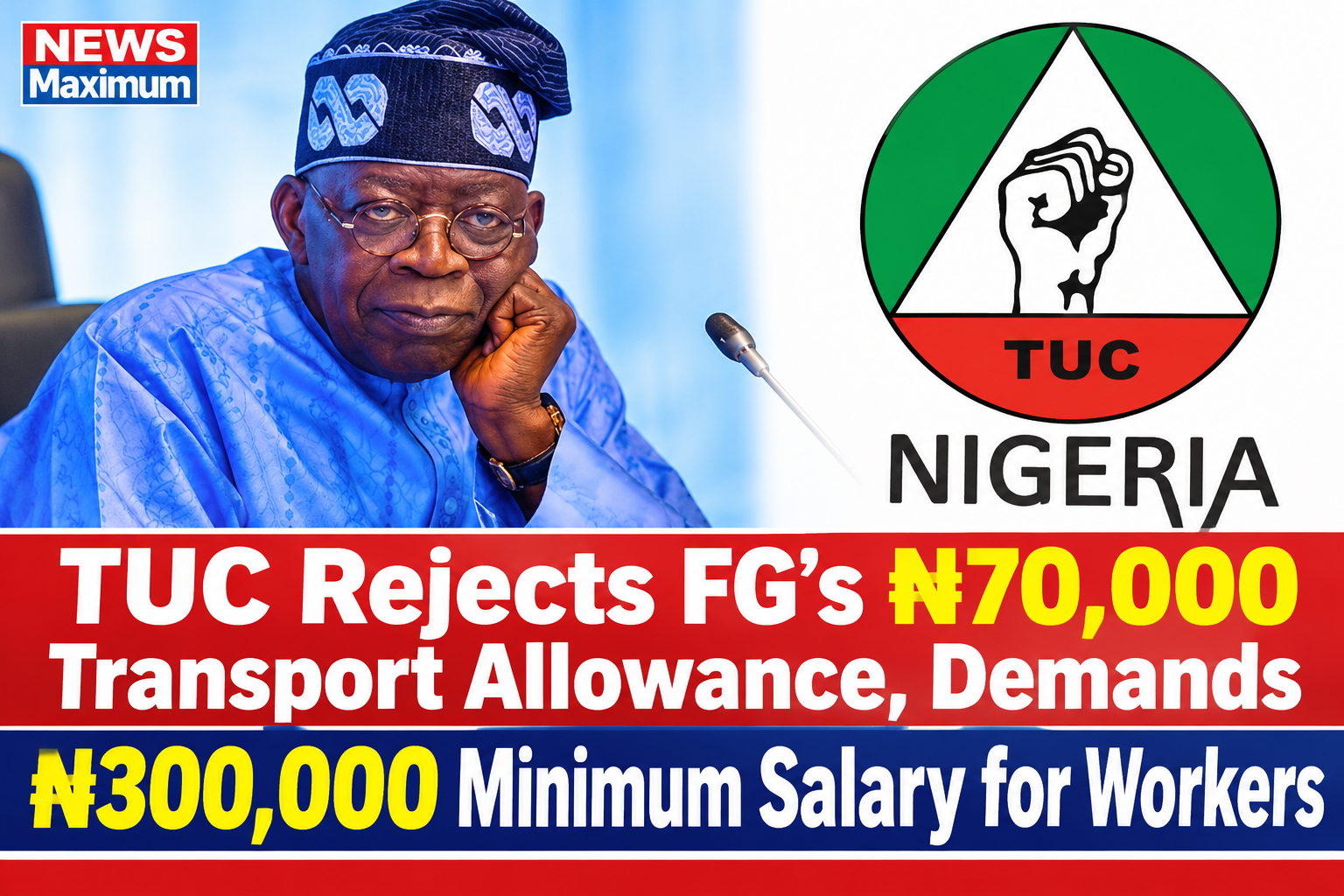
The Trade Union Congress of Nigeria (TUC) has rejected the Federal Government’s proposed ₦70,000 monthly transportation allowance for workers, insisting that a permanent salary increase would provide more meaningful and sustainable relief amid the country’s worsening economic hardship.
The labour organisation said temporary financial interventions were inadequate to address the rising cost of living, arguing that Nigerian workers needed improved salaries they could depend on rather than allowances that would expire after a few months.
The TUC made its position known in a statement issued on Wednesday, October 28, 2026, by its President, Comrade Festus Osifo, and Secretary-General, N.A. Toro, following a National Administrative Council meeting in Abuja.
The congress called on President Bola Tinubu’s administration to immediately review workers’ salaries, proposing that the monthly earnings of the lowest-paid federal worker should be increased from the existing ₦70,000 minimum wage to ₦300,000, with appropriate consequential adjustments across other salary grades.
According to the TUC, the Federal Government does not need to wait for another national minimum wage negotiation before improving workers’ earnings, stressing that there is no law restricting government from paying salaries above the established minimum wage.
The congress explained that minimum wage negotiations and general salary increases were separate matters that could be addressed independently to ease the financial difficulties confronting Nigerian workers.
It also pointed to some state governments that have introduced minimum wages above ₦100,000, arguing that the Federal Government has the capacity to implement a more substantial salary adjustment.
The rejection followed the Federal Government’s announcement of a ₦70,000 monthly transportation allowance for public servants for six months, beginning in November 2026.
The intervention was announced after a conciliation meeting involving government representatives and the leadership of the Nigeria Labour Congress (NLC) in Abuja on October 27, 2026.
The agreement also provided for the payment of outstanding 40 per cent peculiar allowance arrears dating back to May 1, 2026, in three equal monthly instalments beginning in November.
However, the TUC maintained that another temporary wage intervention would not adequately address the economic challenges facing workers, particularly given the government’s previous difficulties in implementing similar agreements.
Explaining its concerns, the congress recalled the ₦40,000 wage award negotiated between the Federal Government and organised labour in October 2023 as an interim measure pending the conclusion of negotiations on a new national minimum wage.
According to the TUC, the previous arrangement was not fully implemented, leaving some workers without their complete entitlements.
The congress alleged that some employees were still owed one or two months of the previous wage award, while others received irregular payments and had to repeatedly follow up before receiving their money.
It further claimed that more than 80 per cent of states and workers in the informal sector did not benefit from the previous intervention.
The labour organisation questioned why workers should be expected to trust another temporary arrangement when outstanding obligations from an earlier agreement had allegedly not been fully settled.
The TUC also demanded the immediate implementation of outstanding agreements with the Joint Health Sector Unions (JOHESU), particularly concerning the adjustment of the Consolidated Health Salary Structure (CONHESS).
It said JOHESU suspended its industrial action in good faith after reaching an agreement with the Federal Government through a conciliation process involving the relevant ministries and organised labour.
However, the congress accused the government of failing to implement the agreed CONHESS adjustment, despite the passage of several months.
It therefore demanded the immediate implementation of the agreement, a clear timetable for its execution and the provision of necessary budgetary allocations to ensure that the affected health workers receive their entitlements.
Beyond salary adjustments and outstanding labour agreements, the TUC urged the Federal Government, state governments and local authorities to introduce practical measures to reduce the cost of essential goods and services.
It identified rising food prices, transportation expenses, healthcare costs and other household necessities as major sources of financial pressure on Nigerian families.
The congress stressed that the economic crisis was not restricted to federal civil servants, noting that state and local government employees, pensioners, private-sector workers and people operating in the informal economy were equally affected.
It called for the timely payment of salaries and pensions, protection of existing jobs, an end to exploitative labour practices and the revitalisation of the productive sector to create decent employment opportunities.
The TUC maintained that workers were not asking the government for favours but demanding improved living conditions, respect for collective agreements and policies capable of protecting their purchasing power.
The disagreement has also exposed differences within organised labour over the Federal Government’s transportation allowance.
While the TUC rejected the arrangement, the Joint National Public Service Negotiating Council (JNPSNC), trade union side, subsequently defended the agreement, describing the ₦70,000 monthly transportation support as a welcome intervention.
In a circular signed by its National Secretary, Comrade Gbenga Olowoyo, the council said the October 27 agreement followed extensive negotiations involving the Federal Government, the NLC, the JNPSNC and JOHESU.
The council maintained that the TUC was not part of the negotiations that produced the agreement, although it acknowledged the congress’s right to express its position on matters affecting workers.
The JNPSNC also encouraged state and local governments to adopt similar arrangements to provide relief for public servants facing increasing transportation costs.
Meanwhile, TUC President Festus Osifo reiterated that the government could improve workers’ earnings without necessarily reopening negotiations on the national minimum wage.
The congress said it would continue to pursue lawful measures to ensure that the government honoured its commitments to workers, adding that temporary relief measures should not replace lasting improvements in salaries and working conditions.
The dispute comes amid continuing pressure on the Tinubu administration to address the effects of rising living costs and ensure that Nigerian workers receive adequate compensation for their labour.