

By Amos Dzege
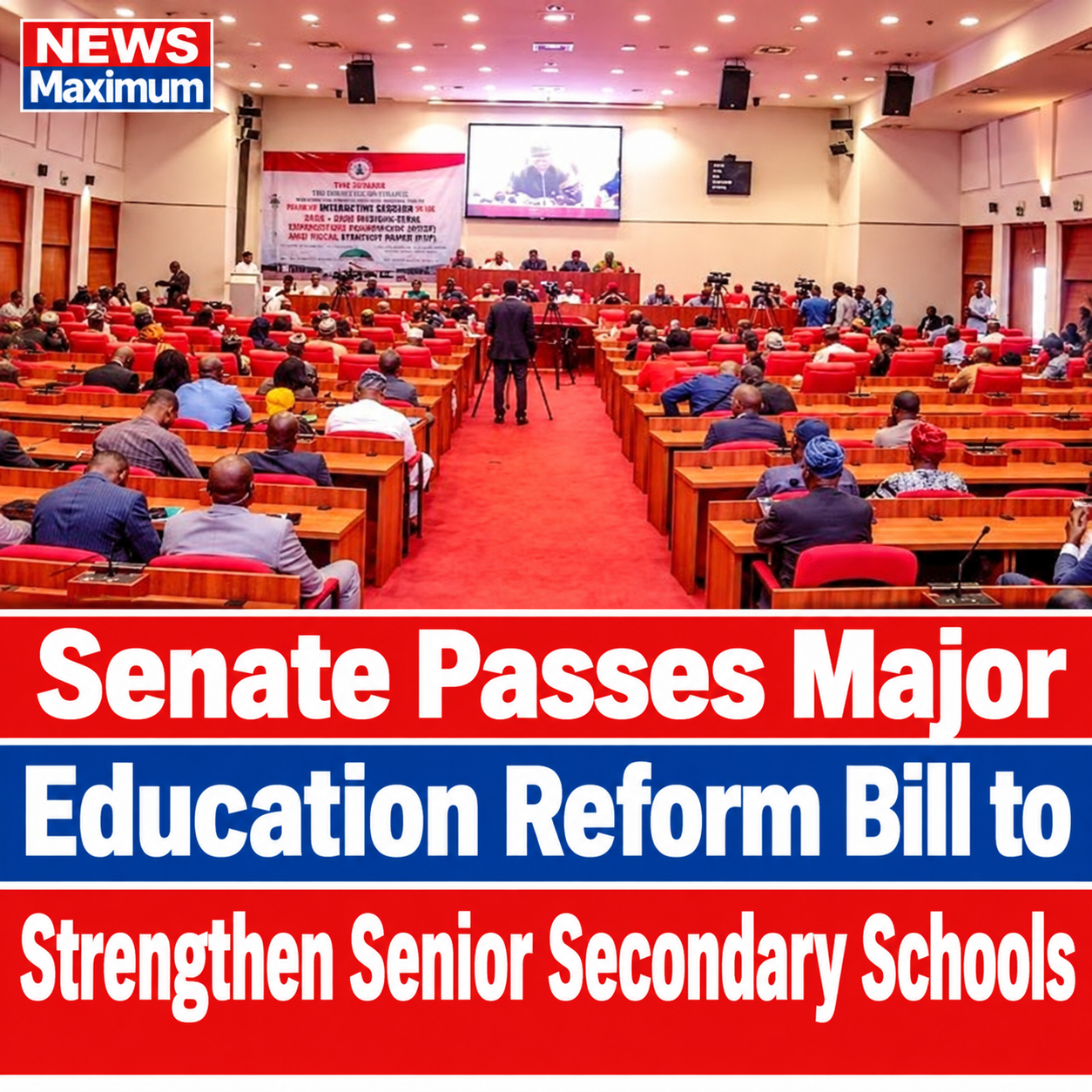
Nigeria’s efforts to improve the administration and quality of senior secondary education have received a fresh legislative boost following the Senate’s passage of a bill seeking to strengthen the National Senior Secondary Education Commission and expand government support for public schools across the country.
The proposed legislation, which was approved during plenary on Wednesday, November 11, 2026, represents another attempt to address persistent weaknesses in the education sector, particularly inadequate infrastructure, insufficient teaching resources, poor coordination and gaps in the delivery of quality education. The development was reported on Thursday, November 12, as lawmakers moved to reinforce the legal framework guiding senior secondary education in Nigeria.
The bill, known as the National Senior Secondary Education Commission Act (Amendment) Bill, 2026, with legislative number SB. 1075, seeks to amend the existing 2023 Act under which the commission was established. Its central objective is to improve the commission’s capacity to regulate, coordinate and support senior secondary education while strengthening accountability across the system.
The Senate approved the legislation after considering the report of its Committee on Education (Basic and Secondary). Senator Orji Uzor Kalu presented the committee’s report on behalf of its chairman, Senator Lawal Adamu Usman, before lawmakers proceeded with a clause-by-clause examination of the proposed amendments.
The bill was subsequently considered at the Committee of the Whole and passed at third reading, with Deputy Senate President Barau Jibrin presiding over the proceedings.
Among the major areas addressed by the proposed amendments is the need to improve funding and provide more direct government intervention in public senior secondary schools. The legislation seeks to support the rehabilitation and development of school infrastructure, procurement of laboratory equipment, provision of instructional materials and professional development for teachers.
It also provides for stronger federal support for Federal Unity Colleges and senior secondary schools operated by the Armed Forces, with appropriate administrative guidelines and coordination involving the National Senior Secondary Education Commission and other relevant authorities.
Another important aspect concerns the composition of state education boards. The proposed amendment to Section 23(1)(b) of the existing Act provides for representation from each of the three senatorial districts in every state, with at least one of the three representatives being a woman. The arrangement is intended to improve geographical representation and inclusiveness in the administration of senior secondary education.
While presenting the committee’s findings, Kalu explained that the experience gained from implementing the 2023 legislation had exposed areas requiring further attention. He said the proposed changes were designed to strengthen governance, improve cooperation between federal and state authorities and ensure that national education policies were implemented more effectively.
The committee also undertook consultations with relevant stakeholders, including representatives of the Federal Ministry of Education, the Nigeria Union of Teachers and the Academic Staff Union of Secondary Schools. Their submissions were examined during the legislative process and incorporated into the committee’s recommendations.
The amendment comes against the background of persistent difficulties confronting public secondary schools in Nigeria. Many institutions continue to struggle with deteriorating classroom facilities, inadequate laboratories, shortages of learning materials and insufficient opportunities for teachers to improve their professional skills.
These challenges have continued to raise questions about the quality of education available to students, particularly those preparing for higher education, technical training and entry into the labour market.
The National Senior Secondary Education Commission was established through the 2023 Act to prescribe and enforce minimum standards, promote quality assurance and coordinate the development of senior secondary education nationwide. The new legislative intervention is intended to strengthen that responsibility and make government support more effective.
The amendment bill was sponsored by Senate Leader Opeyemi Bamidele as an executive proposal. President Bola Tinubu had transmitted it to the Senate in July 2026 after the Federal Executive Council approved the proposed changes at its meeting on April 30, 2026.
With the Senate’s approval on November 11, the legislation has cleared an important stage of the National Assembly’s lawmaking process. However, it is not yet an operative law. It must still complete the remaining legislative requirements, including consideration and concurrence by the House of Representatives, before being transmitted to the President for assent.
The passage has therefore placed renewed attention on the Federal Government’s responsibility to improve the conditions under which millions of Nigerian students receive their secondary education. Its eventual impact will depend not only on the final approval of the amendments but also on the availability of funding, effective implementation and sustained cooperation among the different levels of government.
For students, teachers and communities that depend on public schools, the proposed changes offer an opportunity to strengthen the institutions responsible for preparing young Nigerians for further education and the demands of an increasingly competitive economy.