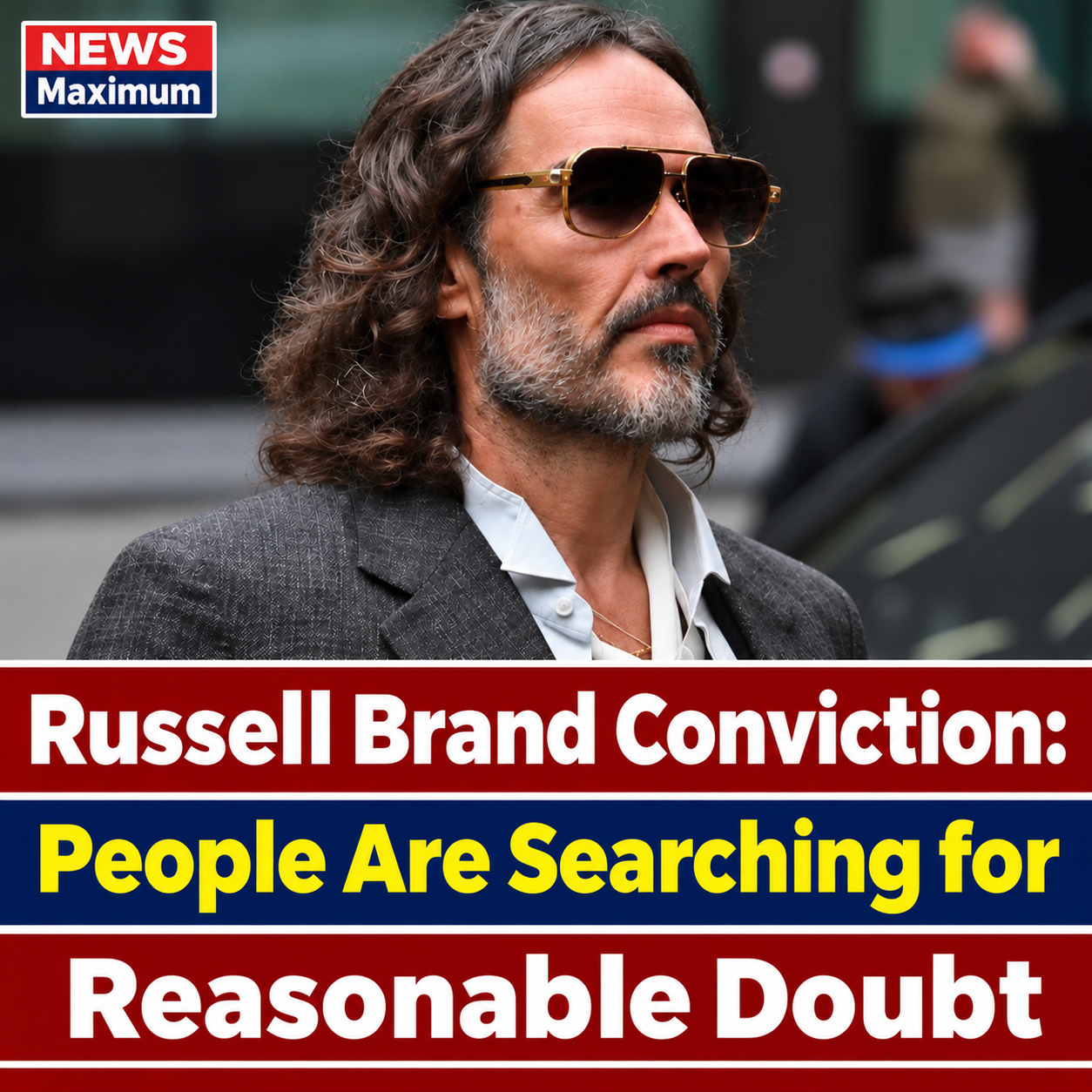
Following the conviction of British comedian and media personality Russell Brand for rape and sexual assault, a heated debate has emerged online, with some commentators questioning the British judicial system and arguing that the principle of reasonable doubt was thrown under the bus.
Brand was convicted at Southwark Crown Court on November 5, 2026, of one count of rape and three counts of sexual assault involving four women. He was acquitted of two other rape charges and one count of attempted indecent assault. He was subsequently sentenced to 10 years and six months in prison.
However, the verdict has continued to generate debate among sections of the online community, with some questioning whether the evidence presented was sufficient to secure convictions, particularly given that the alleged incidents took place several years ago.
Some commentators have argued that if the case had been prosecuted in the United States, the outcome might have been different, suggesting that American juries could have approached the evidence differently.
Others have advanced a political interpretation of the case, alleging that elements of the establishment or political left were hostile towards Brand because of his increasingly outspoken criticism of powerful institutions. These remain opinions and allegations circulating among commentators, rather than established findings about the motives behind the prosecution.
A recurring argument among critics concerns the difficulty of establishing what happened behind closed doors, particularly in sexual offence cases where the complainant and defendant may have been the only people present during an alleged incident.
Some have questioned the absence of DNA or other forensic evidence and argued that the passage of time makes it difficult to independently establish the circumstances surrounding historical allegations.
However, the absence of DNA evidence does not automatically mean that a rape allegation cannot be proved. The prosecution’s case involved testimony from the complainants, witness accounts and other investigative material. Police said they interviewed more than 100 witnesses, collected over 400 witness statements and reviewed more than 1,400 documents.
The controversy has also attracted some extreme reactions online, including claims that members of the jury were compromised or that their decisions had been bought. No verified evidence has been established to support those allegations.
The debate intensified following comments by Brand’s father, Ron Brand, who publicly described his son as the victim rather than the women he was convicted of assaulting.
Speaking to journalists outside Southwark Crown Court following his son’s sentencing, Ron Brand questioned the verdict and expressed disbelief in the British justice system.
When a journalist asked whether he had a message for the women involved in the case, he responded by asking whether the reporter meant Russell. He subsequently described the women as people who had chased and harassed his son.
He also suggested that it was possible the jury had been corrupted, questioning whether social media could have influenced the selection of jurors.
His comments have added another dimension to the public debate, particularly among those already questioning the verdict.
There was also a heated exchange involving Brand’s defence barrister, Ian Winter KC, and Sunday Times journalist Rosamund Urwin, who was among the journalists involved in the original investigation that brought the allegations against Brand into the public spotlight in 2023.
Following the guilty verdict, Winter confronted Urwin outside the courtroom, reportedly telling her: “I hope you are pleased with yourself.”
When the journalist responded that she was pleased justice had been done, the barrister replied: “Well, it wasn’t. You f***ed it.”
The exchange attracted considerable attention, particularly because Winter had previously argued during the proceedings that the reporting by The Sunday Times, The Times and Channel 4’s Dispatches had prejudiced the case against his client and undermined his right to a fair trial.
The barrister subsequently referred himself to the Bar Standards Board following the incident, allowing the professional regulator to examine his conduct.
Brand’s conviction has also prompted comparisons with the American case involving music mogul Sean ‘Diddy’ Combs.
Combs faced serious federal charges, including racketeering conspiracy and sex trafficking involving his former partner, singer Cassie Ventura, and another woman identified in court as Jane.
Despite extensive testimony during the trial, a US jury acquitted Combs of racketeering conspiracy and two sex-trafficking charges. However, it convicted him on two counts of transporting individuals for prostitution.
For some commentators, the contrasting outcomes raise questions about how different legal systems assess evidence, credibility and the criminal standard of proof.
The comparison, however, is not a direct one, as the two defendants faced different charges, evidence and legal proceedings.
Meanwhile, Brand’s conviction has become another flashpoint in the wider debate about celebrity, political influence, sexual offence prosecutions and public confidence in the justice system.
It is important to distinguish between questioning a court’s decision and alleging that a judge or jury acted corruptly. The former is a legitimate part of public debate; the latter requires credible evidence.
NewsMaximum does not endorse allegations of jury corruption or political interference, nor does it encourage anyone to take the law into their own hands.
The wider question remains: Are people questioning the evidence in Russell Brand’s case, or has his conviction become another battleground in the public’s growing distrust of powerful institutions and the justice system?