

By Amos Dzege
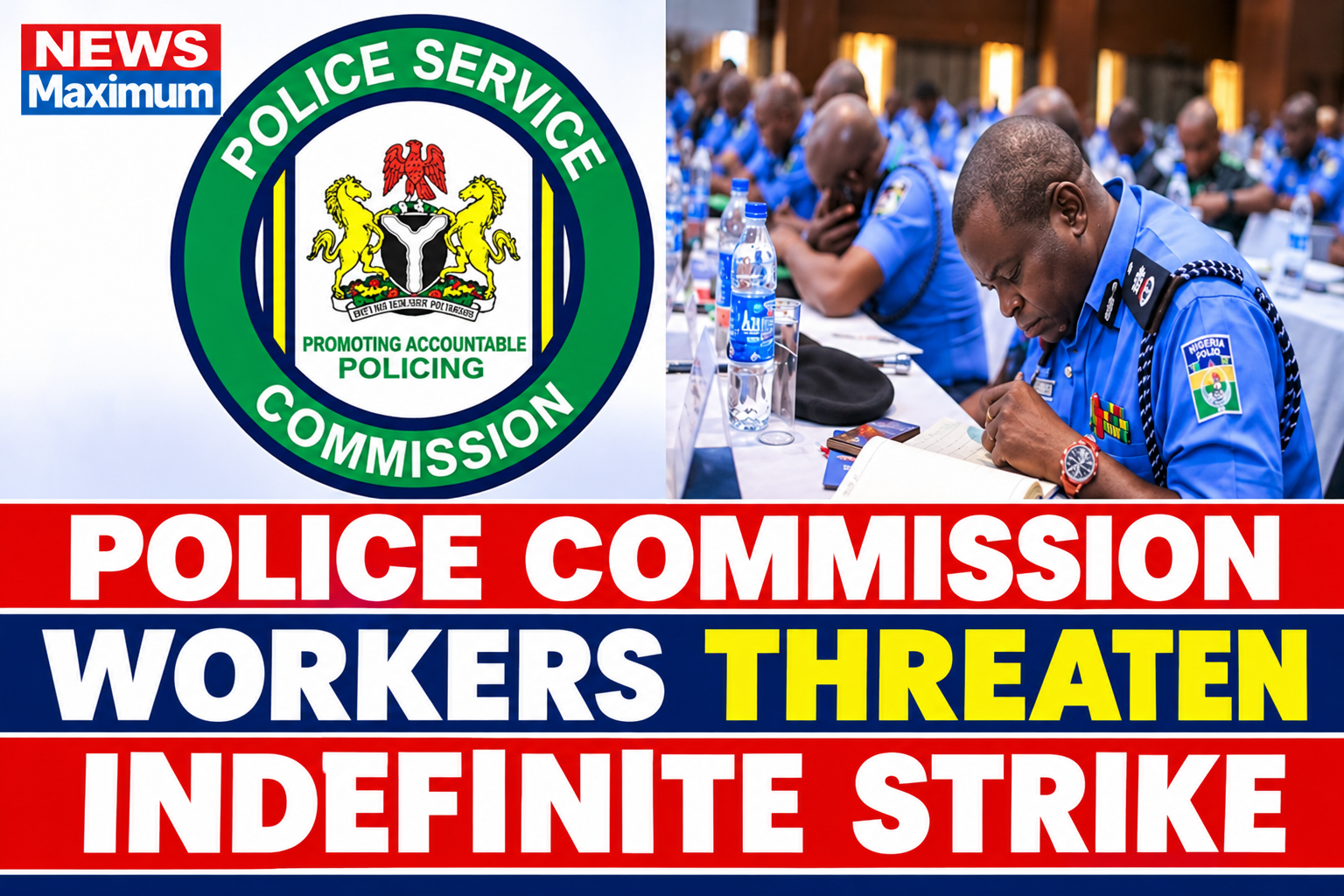
Workers of the Police Service Commission (PSC) are threatening an indefinite strike over several unpaid allowances and welfare-related entitlements, raising concerns about a possible disruption of activities at the commission if the dispute is not resolved.
The industrial action threat follows years of accumulated financial claims involving official assignments, election monitoring exercises and other duties performed by staff members. At the centre of the latest disagreement are outstanding allowances for the 2022 governorship elections in Ekiti and Osun states, as well as the 2023 general elections.
The workers, through their unions, have given the commission’s management a seven-day ultimatum to address their demands, warning that failure to settle the outstanding liabilities would leave them with no option but to embark on an indefinite industrial action.
The dispute was formally raised following a meeting of the Joint Union Congress of the Police Service Commission held on November 2, 2026, at the commission’s headquarters in Jabi, Abuja. The unions subsequently issued a communiqué dated November 5, outlining the grievances and demanding immediate payment of all outstanding staff entitlements.
In a further letter dated November 10, the unions formally notified management of their intention to embark on an indefinite strike after the expiration of the seven-day ultimatum.
The unions are made up of the PSC units of the Association of Senior Civil Servants of Nigeria and the Nigeria Civil Service Union.
Apart from the election-related payments, the workers are demanding outstanding Duty Tour Allowances (DTAs), which cover official trips and assignments undertaken on behalf of the commission.
Other unpaid entitlements reportedly include allowances relating to the Police Academy, the 2016 police recruitment exercise, the Departmental Selection Board and outstanding balances from the 2025 Police Constable medical screening exercise. Some employees are also demanding the remaining balance of their first 28 days’ payment.
The workers alleged that the financial obligations had been carried over from previous administrations and that successive managements had failed to resolve the matter despite repeated correspondence and meetings.
They also claimed that the commission’s former management had sought an intervention fund from the Federal Government to clear the outstanding liabilities, alleging that the current leadership had access to the arrangement but had yet to settle the workers.
According to the unions, some employees had been forced to borrow money, including from private lenders, to finance official assignments because the necessary allowances were not provided before deployment. They further alleged that some colleagues had died while still indebted as a result of the financial difficulties.
The workers’ concerns are not limited to unpaid allowances. In their November 5 communiqué, they also complained about what they described as poor staff welfare, inadequate office facilities and unequal opportunities for training.
They specifically raised concerns about the condition of offices in the Wing B section of the commission’s building, arguing that some workplaces were unsuitable for employees, particularly during periods of intense heat. They called for improved working conditions, including the installation of air-conditioning systems where necessary.
The unions also accused management of failing to implement revised Duty Tour Allowance rates for training conducted within the Federal Capital Territory. They further alleged that welfare packages expected to be provided to employees at least twice yearly, in line with a circular issued by the Head of the Civil Service of the Federation, remained outstanding.
Transportation was another major concern, with the workers complaining about insufficient staff buses and the repeated breakdown of existing vehicles. They also requested an upward review of allowances paid to National Youth Service Corps members attached to the commission.
In the November 10 letter, the unions questioned certain management decisions, including the reported purchase of 2026-model vehicles while staff entitlements remained unsettled and employees continued to experience transportation difficulties.
They also alleged that established Public Service Rules were not being adequately followed in some administrative decisions, while expressing concerns about financial transparency and the exclusion of some directors and departmental heads from important management discussions.
However, the commission’s management has rejected suggestions that funds approved for settling the workers’ outstanding entitlements were diverted to purchase new vehicles.
The PSC spokesperson, Torty Kalu, acknowledged that workers were still owed allowances for the 2022 Ekiti and Osun governorship elections and the 2023 general elections. However, he explained that the intervention funds expected from the Federal Government to clear the outstanding liabilities had not been released to the commission.
Kalu maintained that the commission was making efforts to secure the money, adding that the board had appealed to the workers to exercise patience while the process was being pursued.
He explained that funds allocated for the commission’s regular activities, including disciplinary and promotion-related assignments, could not simply be redirected to settle old staff debts without affecting the commission’s ongoing responsibilities.
According to him, the commission’s secretary had repeatedly visited the Accountant-General’s budget office to follow up on the release of the intervention funds.
The spokesperson also denied allegations that money meant for the payment of workers’ outstanding allowances had been used to acquire vehicles, insisting that the funds in question had not been released.
The latest development has brought renewed attention to a dispute that has persisted for several years. In March 2023, PSC employees deployed to different states for the February 25 presidential and National Assembly elections reportedly complained that they had not received their duty allowances and were struggling to finance their return journeys.
At the time, some employees also said they were still being owed payments for the 2022 Ekiti and Osun governorship elections, indicating that the financial disagreement predates the current management’s latest response.
With the unions now issuing a fresh ultimatum, attention is focused on whether the Federal Government will release the intervention funds and whether the commission’s leadership can reach an agreement with the workers before industrial action begins.