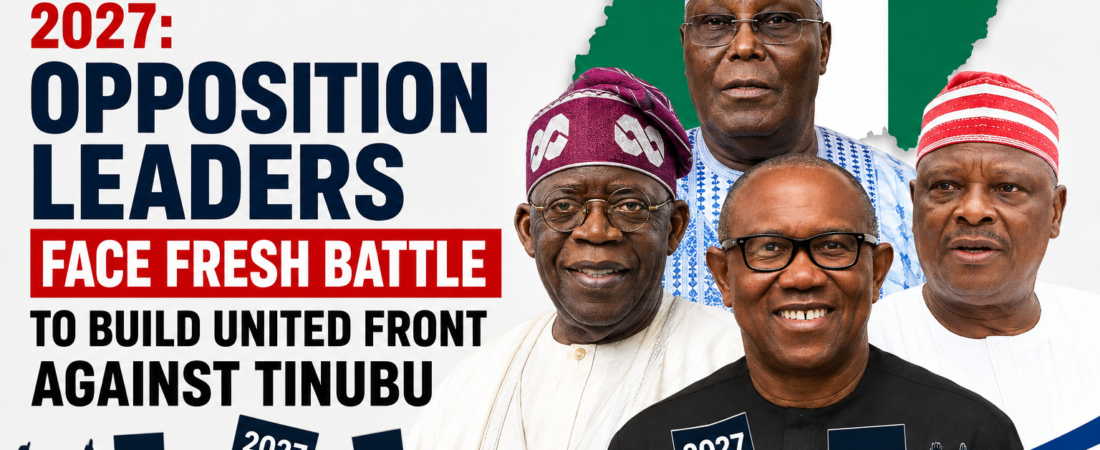
Nigeria’s opposition parties are set for another major test on Monday as political leaders converge in Abuja to explore ways of forging a common front ahead of the 2027 presidential election.
The meeting, being organised by the G-100 under the theme, “A Framework for Opposition Cooperation and Coordination,” is expected to attract representatives and leaders from several opposition platforms, including the African Democratic Congress (ADC), Peoples Democratic Party (PDP), New Democratic Congress (NDC), Allied Peoples Movement (APM), Peoples Redemption Party (PRP) and the Social Democratic Party (SDP).
Although the gathering is not expected to produce an immediate decision on a joint presidential candidate, the meeting is likely to reopen one of the most difficult questions confronting the opposition: how to persuade influential politicians with presidential ambitions to rally behind a single flag bearer.
Former Vice President Atiku Abubakar, former Anambra State Governor Peter Obi, former Kano State Governor Rabiu Kwankwaso and Oyo State Governor Seyi Makinde are among prominent figures whose political interests and ambitions could shape the future of any opposition alliance.
The Abuja engagement comes after an earlier attempt to coordinate opposition forces failed to gain sustained momentum. Political parties and leaders had held discussions in Ibadan in April with the aim of developing a united strategy against the ruling All Progressives Congress, APC, but the arrangement weakened as leading politicians began pursuing presidential aspirations through different political platforms.
The G-100 said the purpose of the latest meeting is to create an organised framework through which opposition parties can discuss areas of common interest, negotiate differences and develop structures for future collaboration.
Part of the proposed arrangement is the establishment of specialised committees expected to examine critical issues and prepare possible agreements for consideration by the participating political parties.
However, analysts say the success of the initiative may ultimately depend on the willingness of the leading political actors to make concessions. Nigeria’s opposition politics has repeatedly been affected by disagreements over leadership, power-sharing and the choice of candidates, with personal ambitions often weakening efforts to form lasting alliances.
The Minister of the Federal Capital Territory, Nyesom Wike, has remained dismissive of the emerging coalition talks, arguing that the opposition lacks the organisation and unity required to seriously threaten President Bola Tinubu’s chances in 2027. According to him, defeating an incumbent government requires early preparation, strong political structures and a clearly coordinated strategy.
Opposition groups, nevertheless, insist that cooperation remains their strongest option if they are to present a formidable challenge to the APC.
Nigeria’s political experience provides mixed lessons for the latest initiative. While several previous alliances have collapsed amid internal disputes, the merger of opposition parties that produced the APC and ended the tenure of an incumbent administration in the 2015 election remains a reminder of what a united political movement can achieve.
As the Abuja meeting approaches, attention is expected to shift beyond speeches and promises of cooperation to the practical steps the parties can agree upon for managing their differences.
For many observers, the central issue is no longer whether opposition leaders desire unity, but whether they are prepared to make the political compromises required to achieve it.
The Abuja summit may not immediately settle the question of who will emerge as the opposition’s presidential candidate in 2027. Its greater significance could lie in whether it produces a credible process capable of bringing competing ambitions together and laying the foundation for a united challenge against President Tinubu.