
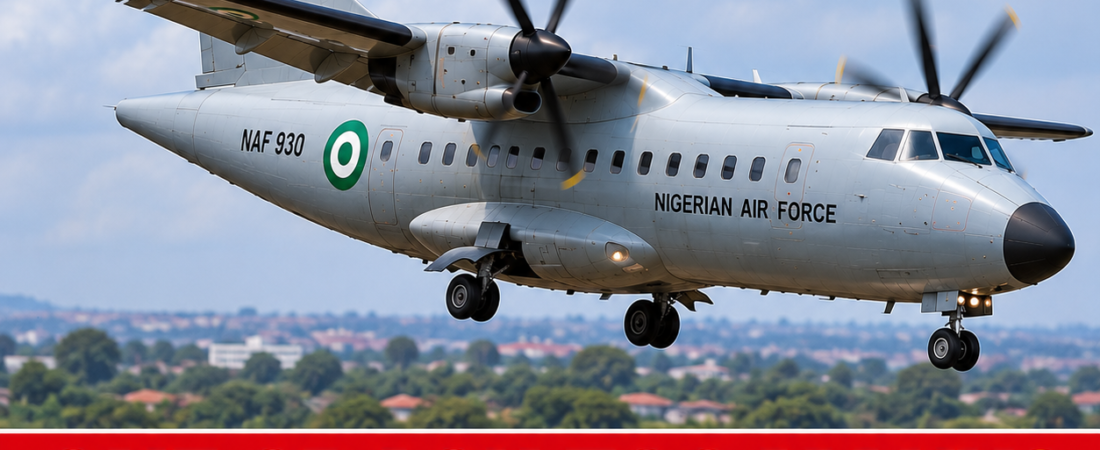
The latest military aircraft crash in Nigeria has renewed questions about safety within the country’s military aviation sector. A Nigerian Air Force ATR-42, identified as NAF 931, crashed on Monday, October 5, 2026, in the Igbokoda area of Ilaje Local Government Area, Ondo State, while on a routine mission from Benin to Lagos. The aircraft lost contact with air traffic controllers before the wreckage was located near a naval base. The Nigerian Air Force later confirmed that 25 people — five crew members and 20 passengers — were on board, with no survivors. A comprehensive investigation has been ordered to establish the circumstances surrounding the crash.
The tragedy is the latest in a history of fatal military aircraft crashes in Nigeria. On February 21, 2021, a Nigerian Air Force Beechcraft King Air 350 crashed shortly after taking off from Abuja after the crew reported an engine failure, killing all seven people on board. Just three months later, on May 21, another NAF King Air 350 crashed near Kaduna International Airport, killing all 11 people aboard, including the then Chief of Army Staff, Lt.-Gen. Ibrahim Attahiru.
These incidents, alongside other military aviation accidents involving helicopters, fighter aircraft, training planes and transport aircraft over the years, have repeatedly brought military aviation safety into focus. While the circumstances and causes of individual crashes may differ, the latest tragedy inevitably raises questions about aircraft airworthiness, maintenance, operational procedures, training, weather conditions and safety oversight. The cause of the Ondo crash, however, remains under investigation.
Nigeria cannot afford to keep losing highly trained military personnel in aircraft accidents. Beyond the immediate human cost, every loss of a pilot, officer or other service member represents a loss of valuable experience and capability at a time when the country continues to face significant security challenges.
Something needs to be done to prevent avoidable aviation tragedies. Investigations into military aircraft accidents should not only establish what went wrong but should also produce practical lessons and, where necessary, improvements in maintenance, training, equipment and operational procedures.
Nigeria simply does not need another military aircraft crash.
At the same time, the country’s civilian aviation industry deserves recognition for its recent safety record. Despite occasional incidents and operational challenges, Nigeria’s commercial aviation sector has maintained a period without a fatal commercial air accident. The contrast highlights the importance of sustained safety oversight, regulatory compliance, maintenance standards and continuous attention to aviation risks.
The latest tragedy should therefore prompt a serious national conversation — not about assigning blame before investigators establish the facts, but about what can be done to make Nigeria’s military aviation safer and prevent another devastating loss of life.