By Amos Dzege
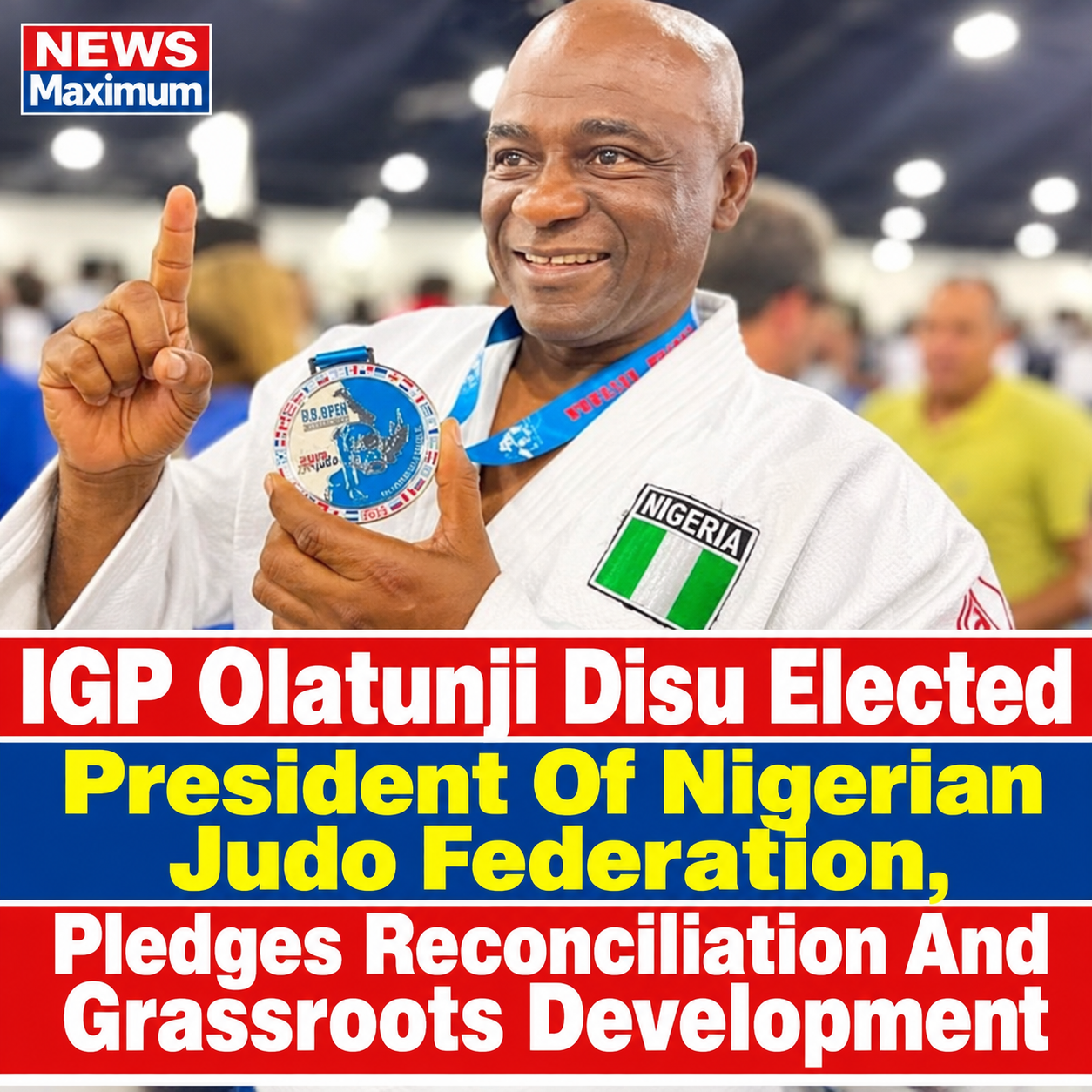
Nigeria’s judo community has a new leader, with Inspector-General of Police (IGP), Olatunji Disu, emerging President of the Nigeria Judo Federation (NJF) following an elective congress held in Abuja on Thursday, November 19, 2026.
Disu secured the support of all 13 eligible voters at the federation’s National Elective Congress, emerging unopposed in an election organised by the Sheriff Hammed-led Caretaker Committee at the Media Centre of the Moshood Abiola National Stadium.
His emergence brings a serving police chief with considerable experience in competitive judo into the federation’s top leadership position, at a time when stakeholders are seeking greater unity, improved athlete development and stronger international participation for the sport in Nigeria.
Speaking shortly after his election, Disu identified reconciliation as his immediate priority, saying his administration would work towards bringing together individuals and groups whose disagreements had affected relationships within the judo community.
He stressed that the future of the sport should take precedence over personal interests, pledging to reconnect with Nigerian judokas both within the country and those living abroad who had become disconnected from the federation.
According to him, rebuilding confidence among stakeholders would be necessary to establish a stronger foundation for the development of judo and ensure that more Nigerians have opportunities to participate in the sport.
Beyond reconciliation, the new federation president outlined plans to strengthen grassroots participation by taking judo to secondary schools, universities and polytechnics, which he identified as important platforms for discovering and nurturing young sporting talents.
Disu, a third-dan black belt holder, began practising judo in 1986 and has accumulated considerable experience as both an athlete and sports administrator. His achievements include gold medals at the 1990 National Sports Festival, the Nigerian Police Games and several veterans’ competitions.
He also won a silver medal in the veterans’ under-100kg category at the 33rd US Open Judo Championship in July 2022.
Before his election, Disu served as Chairman of the Lagos State Judo Association and as Patron of the Nigerian Police Judo Association, positions that have given him experience in the organisation and promotion of the sport.
Other officials elected alongside him include Sir Nwaobilor Ananaba as First Vice President and Barrister Emmanuel Ghahabo as Second Vice President.
The new board also comprises Catherine Ewa-Ekuta, Bassey Ekanem Ekwere, Ika Bassey Odo, Ezeri Agahata, Chijioke Okechukwu, David Jesuorobo Osaghae, Dr Lawrence Ezeudu, Osahon Eke, Engr. Tokunbo Ajanaku, Rosa Collins, Salisu Mahmuda and Sunday Ewa, representing different stakeholder groups, technical interests and Nigeria’s geopolitical zones. Two additional members are expected to be co-opted into the board.
Meanwhile, Caretaker Committee Chairman Sheriff Hammed described the successful election as an important step towards restoring elected leadership to the federation.
He congratulated the judo community and urged stakeholders to support the new administration, maintaining that the interest and development of the sport must remain the federation’s central priority.
Hammed also acknowledged the contributions of the National Sports Commission, particularly its Chairman, Shehu Dikko, and Director-General, Bukola Olopade, towards efforts to reposition Nigerian judo.
In his first major assignment after emerging federation president, Disu also declared open the inaugural IGP Olatunji Disu Inter-Club Judo Championship in Lagos, which attracted 20 registered teams.
At the event, he emphasised the importance of cooperation among sporting organisations and security agencies, while calling for greater investment in coaching, technical development and international participation.
He also indicated that discussions were underway to secure technical assistance for Nigerian coaches, noting the need for the country to return to regular participation in international judo competitions.
Disu’s emergence therefore presents an opportunity for the Nigeria Judo Federation to address longstanding divisions, expand participation among young people and improve the country’s competitiveness at international tournaments.
The major test for the new leadership will be its ability to translate its promises of reconciliation, grassroots expansion and improved technical capacity into concrete programmes that can strengthen Nigerian judo and create better opportunities for athletes.