


By Amos Dzege
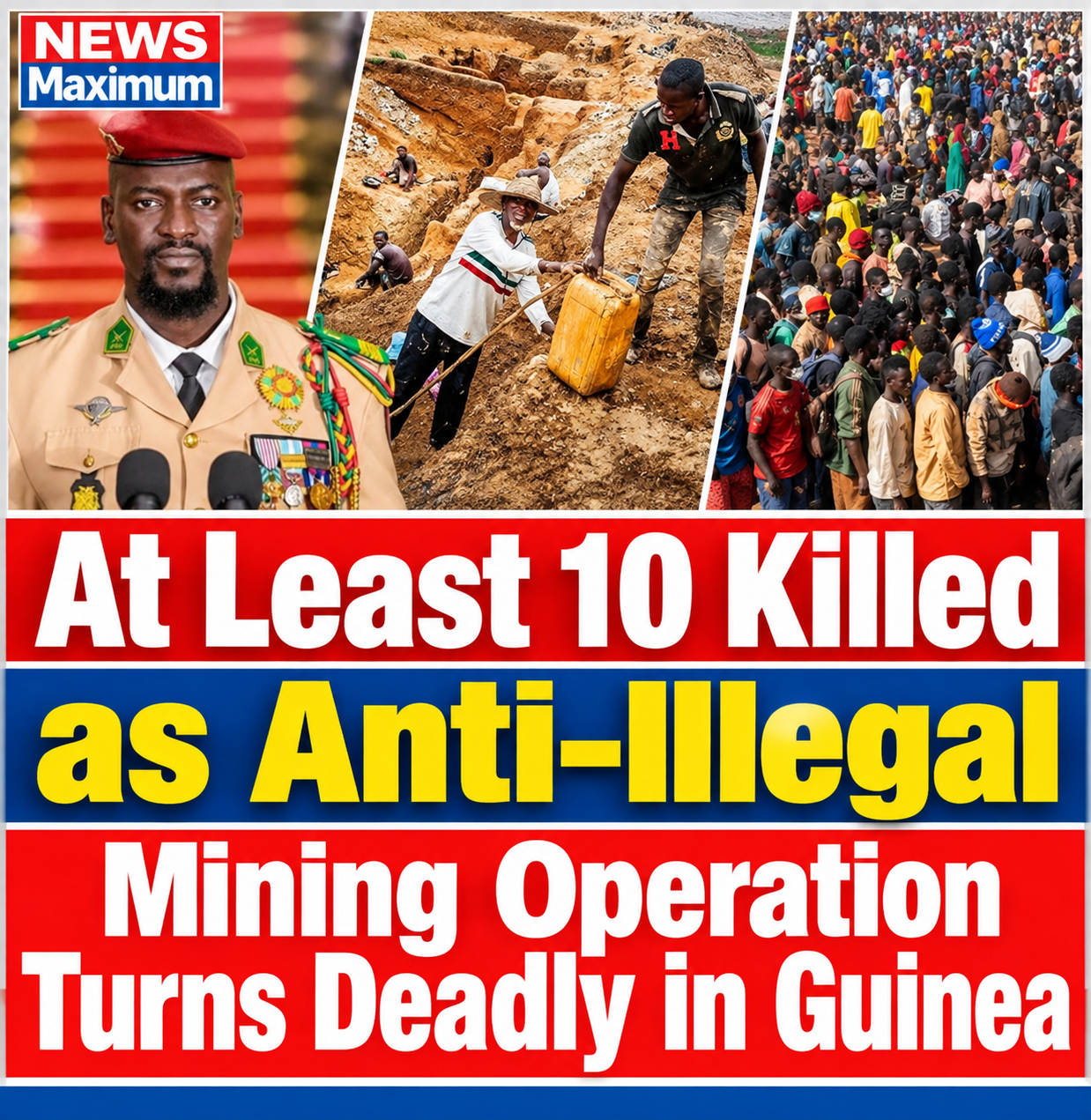
A government campaign to stop illegal gold mining in northeastern Guinea has ended in deadly violence, leaving at least 10 people dead and 13 others injured after protesters and security personnel clashed during an enforcement operation in the country’s gold-producing region.
The confrontation occurred on Wednesday, November 11, in Balato, within the Siguiri region, where security forces had been deployed to ensure compliance with restrictions on artisanal and unauthorised gold mining. What began as an operation to enforce government regulations quickly deteriorated into a violent confrontation involving firearms, according to information released by Guinean authorities.
The Ministry of Territorial Administration said protesters erected barricades across public roads in an attempt to obstruct the security patrol. Tensions subsequently escalated, resulting in an exchange of gunfire between the opposing sides. However, the government has not established publicly who fired the first shot or provided a complete account of how the confrontation unfolded.
Provisional figures released by the authorities put the death toll at 10, including five foreign nationals whose identities were still being established. Another 13 people sustained injuries, with civilians and members of the country’s defence and security forces among those affected.
The violence also resulted in significant damage to property. According to the government, two pickup trucks and a vehicle belonging to security personnel were set ablaze during the confrontation. Protesters also reportedly seized a firearm and a motorcycle belonging to the security forces.
Authorities have referred the incident to judicial officials for investigation, with the responsibility for determining the circumstances surrounding the deaths and the violence placed before the relevant legal authorities.
The incident comes amid an increasingly aggressive campaign by Guinea’s government against unauthorised gold extraction. On November 2, authorities introduced a ban on artisanal gold mining in Siguiri, arguing that unregulated mining activities had contributed to serious environmental destruction.
Government officials have raised concerns about the impact of mining operations on agricultural land, rivers and vegetation. They particularly blame the use of heavy machinery and harmful chemicals for damaging farmland and contaminating water sources, creating environmental problems for communities that depend on agriculture and other natural resources.
The enforcement campaign has already resulted in large-scale arrests. More than 1,200 people suspected of involvement in illegal mining activities were detained earlier this month, while mass court proceedings against suspected offenders have commenced in the capital, Conakry.
However, the restrictions have created considerable economic difficulties for thousands of people who depend on small-scale gold mining for their survival. Artisanal and small-scale mining provides livelihoods for more than 300,000 people in Guinea, making the government’s crackdown a particularly sensitive issue in communities where gold extraction is a major source of income.
The consequences have also extended beyond Guinea’s borders, with neighbouring countries experiencing an influx of people leaving mining communities following the restrictions.
Malian authorities have reported that approximately 100,000 people arrived in Bamako, the country’s capital, while nearly 60,000 others reached the border town of Kouremale after leaving Guinea. Burkina Faso, meanwhile, announced that it had repatriated 45,406 of its citizens affected by the developments.
The growing displacement has added another dimension to the crisis, raising concerns about the welfare of families who have suddenly lost their sources of income and, in some cases, been forced to return to their countries of origin.
Although Guinea’s government maintains that the restrictions are necessary to protect the environment and restore order in the mining sector, the latest bloodshed highlights the difficulties of enforcing such measures in communities where thousands of people depend on informal mining for their livelihoods.
With judicial investigations now expected to establish responsibility for the deadly confrontation, questions remain about how the government will balance its environmental protection campaign with the economic needs of mining communities and the protection of civilians.
For now, the deaths in Balato have turned an already controversial mining crackdown into a major security and humanitarian concern for Guinea and its neighbouring countries.