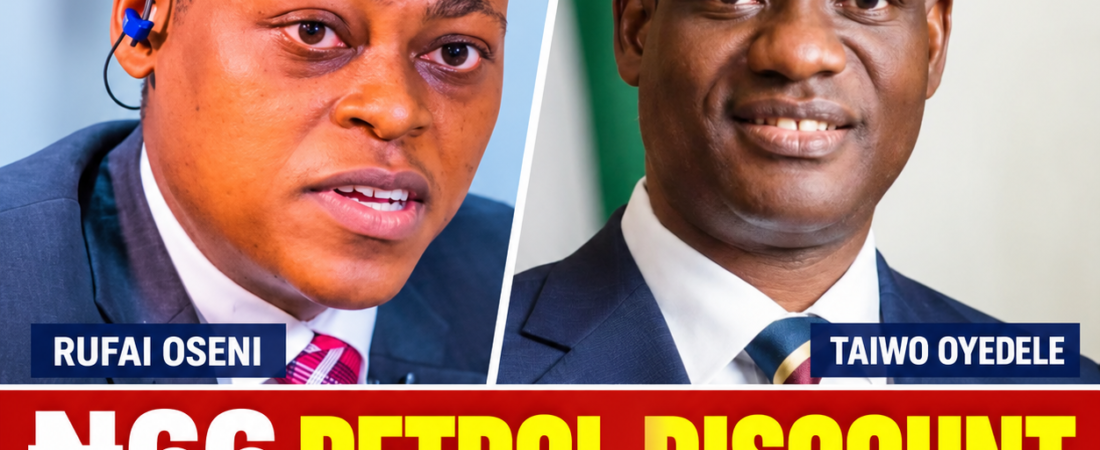
The Federal Government insists that its ₦66-per-litre petrol discount is not a reinstatement of fuel subsidy but a temporary measure to ease the burden of rising petrol prices on Nigerians. However, ARISE News journalist Rufai Oseni has challenged this explanation, arguing that sacrificing profit to reduce the price of a product amounts to a form of subsidy.
So, what is the difference between the government’s position and Oseni’s argument, and what does the evidence reveal?
Why the Government Says It Is Not a Subsidy
On October 8, 2026, Finance Minister Taiwo Oyedele announced that the Nigerian National Petroleum Company Limited (NNPC) Retail would forgo its retail profit margin to sell petrol at cost for an initial 30 days. The arrangement followed a ₦66-per-litre discount introduced on October 1 and subsequently extended until October 31.
Oyedele maintained that the intervention was different from the fuel subsidy regime abolished in 2023 because NNPC Retail would absorb the reduction through its profit margin rather than receive money from the Federal Government to cover the difference.
In its October 9 statement, NNPC reiterated that the initiative was a customer-relief measure, not a restoration of subsidy. The Presidency also defended the arrangement, insisting that the government was providing temporary relief without reversing its market-based petrol pricing policy. (NNPC)
The government’s argument rests on a specific financial distinction: if NNPC Retail is genuinely funding the discount from its own retail margin, without government reimbursement, the arrangement is not the same as the former government-funded fuel subsidy.
Why Rufai Oseni Believes It Is a Subsidy
In a video shared on his official X account, Oseni argued that the government’s description does not change the economic nature of the intervention.
He maintained that when a company deliberately forfeits profit to make a product cheaper for consumers, it is providing an economic benefit that can be described as a form of subsidy. He also questioned the government’s broader approach to price support, including its proposed arrangements involving a ceiling on petrol supply costs.
Oseni’s argument is therefore broader than whether the government has made a direct payment from its budget. He is questioning whether deliberately sacrificing profit to lower prices amounts to subsidising a product, regardless of the terminology used. (Business Times Nigeria)
So, Is It Really a Subsidy?
The answer depends partly on how the term is being used.
Under the conventional fiscal definition, a government-funded fuel subsidy involves public financial support that covers some of the cost of supplying petrol or keeps the consumer price below what it would otherwise be. If NNPC Retail alone bears the cost of the ₦66 discount through reduced earnings, with no government reimbursement, describing it as a direct government-funded subsidy would be inaccurate. However, establishing whether this is the actual arrangement requires transparency about the financial terms and any compensation involved. (NNPC, Discount Offers Relief, Does Not Restore Subsidy)
Oseni raises a broader economic question: does sacrificing profit to reduce the price amount to a form of subsidy? Economically, a company can provide price support by accepting a lower return than it would otherwise seek. However, that fact alone does not establish that the government has reinstated the former fuel subsidy regime. NNPC’s ownership, the source of the funds, the terms of the arrangement and any compensation involved all matter. (TheCable)
There is also an important distinction between the ₦66 retail discount and the government’s proposed ₦1,350 ceiling on petrol’s supply cost. Under the latter proposal, refiners and importers would initially absorb costs above the ceiling and recover the difference later when market conditions improve. Such an arrangement raises additional questions about how those costs would be recovered and whether the mechanism could create subsidy-like effects. The full financial terms would be needed to assess it conclusively. (State House)
Meanwhile, a Punch report published on October 10 found that motorists at the Abuja outlets it visited had to pay through the NNPC Fuel App to obtain the ₦66 reduction. The report also estimated that NNPC could forgo ₦4.62 billion in gross revenue if all 70 million litres of its assumed average monthly sales qualified for the discount. That figure is an estimate of potential forgone revenue, not proof of an equivalent loss in profit or a government subsidy payment. (Punch Newspapers)
Conclusion
The Federal Government’s position is that the ₦66 petrol discount is a temporary commercial concession, not a return to the subsidy regime abolished in 2023. Rufai Oseni, approaching the issue as a journalist and government critic, argues that sacrificing profit to lower consumer prices is itself a form of subsidy. The two positions reflect different interpretations of the intervention, but the distinction ultimately depends on how the arrangement is financed and who bears its cost. (TheCable)
The available evidence supports the conclusion that the government has introduced a temporary price-relief measure. It does not, by itself, establish that the former government-funded subsidy system has been reinstated. Greater transparency about NNPC Retail’s margins, any reimbursement arrangements and the financing of the wider price-support measures would help Nigerians determine whether the policy is simply a commercial discount or a different form of economic support. (NNPC)